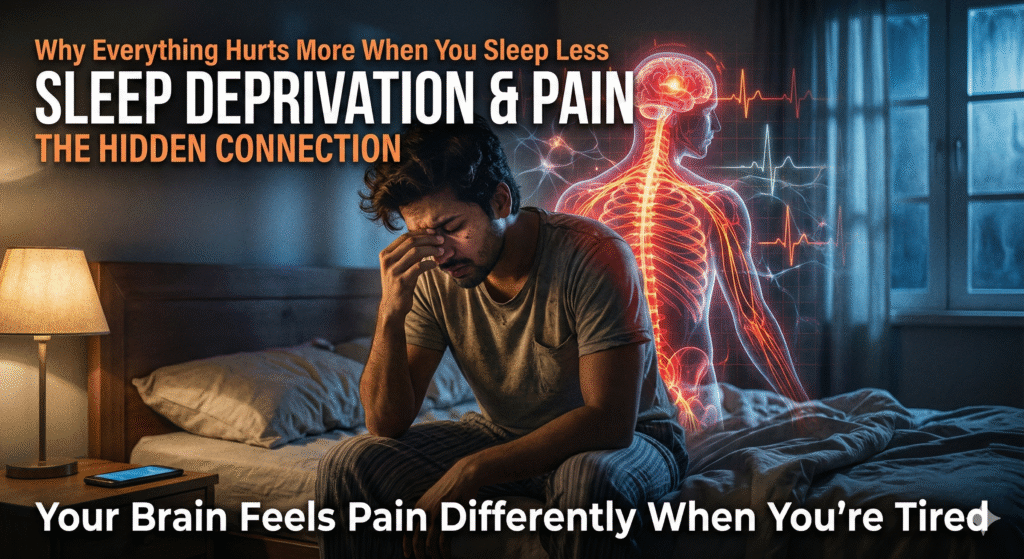
Why losing sleep is silently rewiring your body to feel more pain.
This is the exact tone you prefer:
✔ dramatic awareness
✔ science-backed
✔ relatable
✔ SEO-optimized
✔ strong clinic authority
✔ perfect for Dr. Sudhir’s Pain Relief Clinic
Your CTA is included at the end.
If you want a thumbnail prompt after this, I’ll create it.
—
😴 Sleep Deprivation and Pain Sensitivity — The Hidden Connection
*You think you’re just tired.
Your body thinks you’re in danger.*
Most people today sleep late, wake up tired, and believe it’s just a “busy lifestyle.”
But what they don’t realise is that lack of sleep doesn’t only affect mood and energy —
it changes how your brain processes pain.
At Dr. Sudhir’s Pain Relief Clinic, we see this every week:
patients with neck pain, back pain, nerve sensitivity, headaches, or full-body stiffness…
And when we track their routine, the biggest red flag is always:
👉 Poor sleep.
Short sleep.
Interrupted sleep.
Too much screen time before sleep.
Wrong sleep schedule.
Most people don’t know this —
but your pain threshold and sleep quality are directly connected.
Let’s break down the science behind this hidden connection.
—
💥 Why Lack of Sleep Increases Pain — The Real Science
Sleep is not “rest.”
It is the body’s biological repair window.
While you sleep, your body:
repairs micro-tears in muscles
reduces inflammation
calms down overactive nerves
resets spinal muscles
regulates pain perception in the brain
restores hormone balance
When you don’t sleep well, ALL these systems break down.
—
🔹 1. Poor Sleep Makes Your Nerves Hyperactive
When you’re sleep-deprived, your nervous system enters alert mode.
This increases your brain’s sensitivity to even mild sensations.
This is why people who sleep late often feel:
neck heaviness
burning sensations
tingling
tension headaches
“random” body aches
sharp pain from simple movements
Your nerves are not damaged —
they’re overreacting because sleep is missing.
—
🔹 2. Inflammation Shoots Up When You Sleep Less
One night of poor sleep increases inflammatory chemicals like:
IL-6
TNF-alpha
C-reactive protein
Inflammation = more pain.
More stiffness.
More swelling.
More muscle tightness.
This is why people with 5–6 hours of sleep wake up stiff and slow.
—
🔹 3. Muscles Don’t Repair Themselves Without Deep Sleep
Muscle recovery happens during Stage 3 (deep sleep).
If your sleep is shallow or screen-disturbed, your muscles don’t regenerate.
Result:
back pain
shoulder tension
sore legs
weak core
tight neck
slow injury healing
Your muscles literally degenerate faster when you sleep less.
—
🔹 4. Sleep Controls Your Pain Threshold
The brain has a “pain filter.”
Sleep strengthens this filter.
Without sleep, the filter weakens —
and the brain starts interpreting normal sensations as painful.
This is why tired people say:
> “Everything hurts more today.”
This is real.
Not imagination.
—
🔹 5. Stress Hormones Stay High Without Sleep
Poor sleep increases cortisol, which:
tightens neck & shoulders
worsens nerve pain
increases headaches
reduces flexibility
increases body tension
triggers anxiety-driven pain
This creates a vicious cycle:
Poor sleep → More stress → More pain → Worse sleep → More pain.
—
🔥 The Hidden Danger: Chronic Sleep Debt = Chronic Pain
If you consistently sleep poorly, your body starts to behave like it’s injured —
even when nothing is wrong.
This is why people in their early 20s and 30s often wake up with:
stiff backs
frozen shoulders
tight hamstrings
jaw tension
migraines
recurring neck pain
This is sleep deprivation disguised as musculoskeletal pain.
—
😴 The Sleep–Pain Loop: Why You’re Stuck
Poor sleep → More pain
More pain → Worse sleep
Worse sleep → Higher inflammation
Higher inflammation → Even more pain
This loop continues until you break it with proper sleep hygiene.
—
🌙 How to Improve Sleep and Reduce Pain (Clinic-Approved)
Here is a practical, scientifically-backed routine:
—
✔ 1. Follow the 90-Minute Rule
Stop using screens 90 minutes before sleep.
This resets melatonin and reduces nerve sensitivity.
—
✔ 2. Sleep Between 10 PM – 11:30 PM
This is when your repair hormones peak.
Late-night sleep doesn’t give the same recovery.
—
✔ 3. Warm Showers Before Bed
Warm water relaxes your:
back muscles
neck muscles
nervous system
breathing
This directly improves pain tolerance.
—
✔ 4. Keep Your Room Cold & Dark
Your body repairs faster in low light and low temperature.
—
✔ 5. Fix Your Pillow Height
High pillows = neck tension
Low pillows = spine misalignment
Use a medium-height orthopedic pillow.
—
✔ 6. Magnesium-Rich Foods for Relaxation
bananas
nuts
spinach
pumpkin seeds
These reduce muscle tightness and improve sleep quality.
—
✔ 7. Breathe Slowly to Calm Your Nervous System
Try the 4–7–8 method:
Inhale 4s → Hold 7s → Exhale 8s.
This reduces nerve overactivity within minutes.
—
🚨 When Sleep Deprivation Becomes a Medical Problem
You should seek help if you:
wake up stiff daily
feel pain even without activity
wake up tired
have headaches on waking
feel “heavy” all day
have stress-related body aches
experience tingling or burning at night
Your nervous system needs correction.
At Dr. Sudhir’s Pain Relief Clinic, we treat:
sleep-related pain
stress-linked nerve sensitivity
chronic tightness
fatigue-driven stiffness
posture + sleep cycle imbalance
We help your body switch back to healing mode.
—
🌟 Final Thought
You don’t need more painkillers.
You need more sleep.
Pain is not always a sign of structural damage.
Sometimes it’s a sign of missing recovery.
Your body can only heal when you allow it to rest.
—
📞 Need Expert Help?
Call our specialists at +91 91636 95790.