Your muscles are choosing your posture for you — not the other way around.
Most people think slouching is a conscious mistake:
“Haan, I slouched because I was tired.”
“I forgot to sit straight.”
“I’ll fix my posture when I remember.”
But the truth is much deeper —
You are not choosing to slouch.
Your body is automatically pulling you into your slouch without your permission.
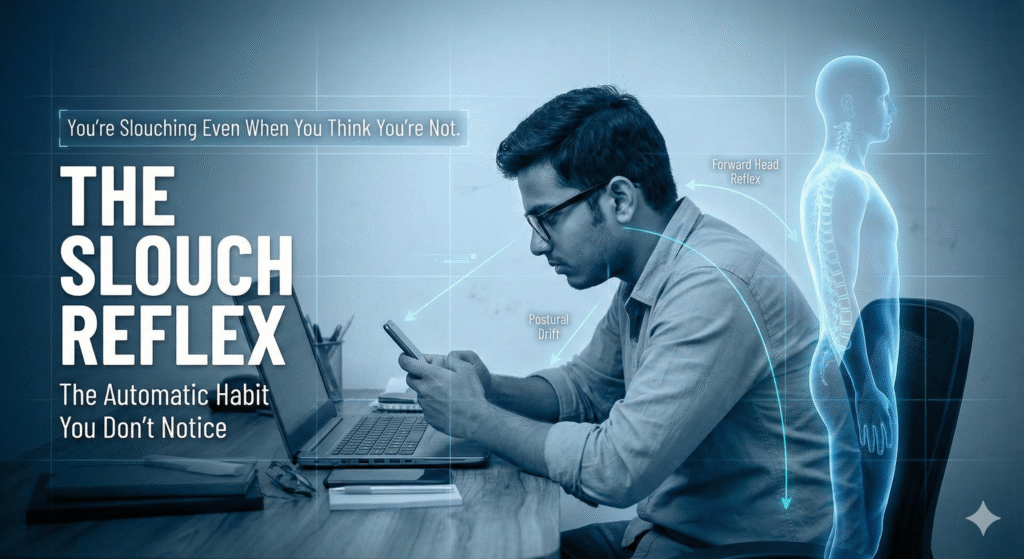
This unconscious, involuntary pull is called the Slouch Reflex.
And it is one of the biggest hidden reasons behind:
neck pain
shoulder tension
back stiffness
forward head posture
weak core
recurring muscle tightness
spinal imbalance
early degeneration
At Dr. Sudhir’s Pain Relief Clinic, we see this in almost every patient who sits long hours or uses devices frequently.
Let’s decode what it really is — and how to break this damaging reflex before it becomes permanent.
—
🧠 What Is the Slouch Reflex?
The Slouch Reflex is an automatic postural response that develops when certain muscles weaken and others tighten due to repeated habits.
Your brain begins to “prefer” the slouched posture because:
it requires less effort
it matches your sitting/phone habits
your stabilizer muscles become too weak to hold you upright
your stretching muscles become too tight to allow straight posture
Over time, your nervous system records slouching as your default posture.
So even when you think you’re “straight,” your body is actually still slouched — just less.
This is why people say:
> “I corrected my posture but it still looks wrong.”
“I stand straight but my neck still shoots forward.”
“No matter what I do, I end up slouching again.”
It’s not your fault.
It’s your reflex.
—
🔍 How the Slouch Reflex Forms (The Science)
Sitting for long hours →
the body slowly shifts into a “resting collapse.”
Three things happen:
—
🔻 1. Weak Core + Weak Upper Back
Your deep stabilizer muscles switch off.
Your body cannot hold you upright anymore, even if you want to.
—
🔻 2. Tight Chest + Tight Hip Flexors
Your front muscles shorten and pull your body forward.
This makes straight posture feel uncomfortable, so your brain avoids it.
—
🔻 3. Neck Falls Forward
Called “Forward Head Posture,” this is the fastest-triggering reflex.
Your neck shifts ahead to match your slouched chest and weak back.
—
Together, these create an automatic loop:
Slouch → Weaker postural muscles → More slouch → Muscle imbalance → Spinal misalignment → Chronic pain
This loop is so strong that your body goes into a slouch even when you’re fully alert.
That’s why it’s called a reflex, not a habit.
—
📉 Symptoms the Slouch Reflex Has Already Started in You
If you notice even two of these, the reflex is active:
You slouch without realising
Straight posture feels tiring
Neck pain by evening
Shoulders naturally round forward
Chest feels tight
Laptop/phone use makes pain worse
Lower back feels stiff after sitting
You can’t maintain upright posture for more than 10 minutes
Your head naturally shifts forward
Most young adults in India have this reflex before age 25 due to screens, stress, and poor movement.
—
⚠️ The Hidden Dangers of Leaving the Slouch Reflex Untreated
Slouching is not a small issue.
It leads to:
🧨 1. Permanent Posture Change
Your spine starts adapting to the curved shape.
🧨 2. Neck Disc Compression
Forward head posture can add 12–15 kg of extra weight on the neck.
🧨 3. Shoulder Impingement
Rounded shoulders pinch nerves.
🧨 4. Lower Back Fatigue
Weak core makes lumbar muscles overwork.
🧨 5. Nerve Sensitivity
Slouching narrows spaces where nerves pass.
🧨 6. Reduced Lung Capacity
Your chest collapses, reducing deep breathing capacity by 20–30%.
🧨 7. Faster Fatigue & Brain Fog
Less oxygen → less alertness → more tiredness.
This is why the Slouch Reflex is a health crisis, not a cosmetic issue.
—
🔄 **Can You Break the Slouch Reflex?
Yes — but not by ‘sitting straight.’**
Correcting posture manually lasts only minutes.
Breaking the reflex requires retraining the body, not forcing it.
Here’s what actually works:
—
💪 1. Strengthen the Right Muscles (Not Just Core)
To reverse the reflex, you must train:
deep core
upper back stabilizers
lower traps
spinal extensors
deep neck flexors
glutes
When these muscles fire → your body naturally sits up straight.
—
🧘 2. Stretch the Tight Areas
To release posture tension:
chest
hip flexors
upper traps
neck extensors
lower back fascia
When the front relaxes, the back can activate again.
—
📐 3. Fix Your Sitting Angle
90-degree seating causes slouching.
Adjust to:
feet flat
slight forward tilt
laptop at eye level
back supported
Ergonomics break reflexes faster.
—
🚶 4. Move Every 30 Minutes
The spine becomes “fresh” again every time you move.
Movement interrupts slouch memory.
—
🧬 5. Guided Physiotherapy for Reflex Correction
At Dr. Sudhir’s Pain Relief Clinic, treatments include:
postural retraining
muscle activation therapy
spinal alignment work
nerve glide therapy
strengthening programs
slouch reflex correction
We don’t just fix the pain —
we fix the reflex beneath the pain.
—
🌟 Final Thought
Your body remembers everything —
even the posture you didn’t mean to adopt.
The Slouch Reflex is not your mistake.
It’s your body’s adaptation to modern living.
But with the right guidance, you can erase the reflex
and build a posture that supports you for life.
—
📞 Need Expert Help?
Call our specialists at +91 91636 95790.