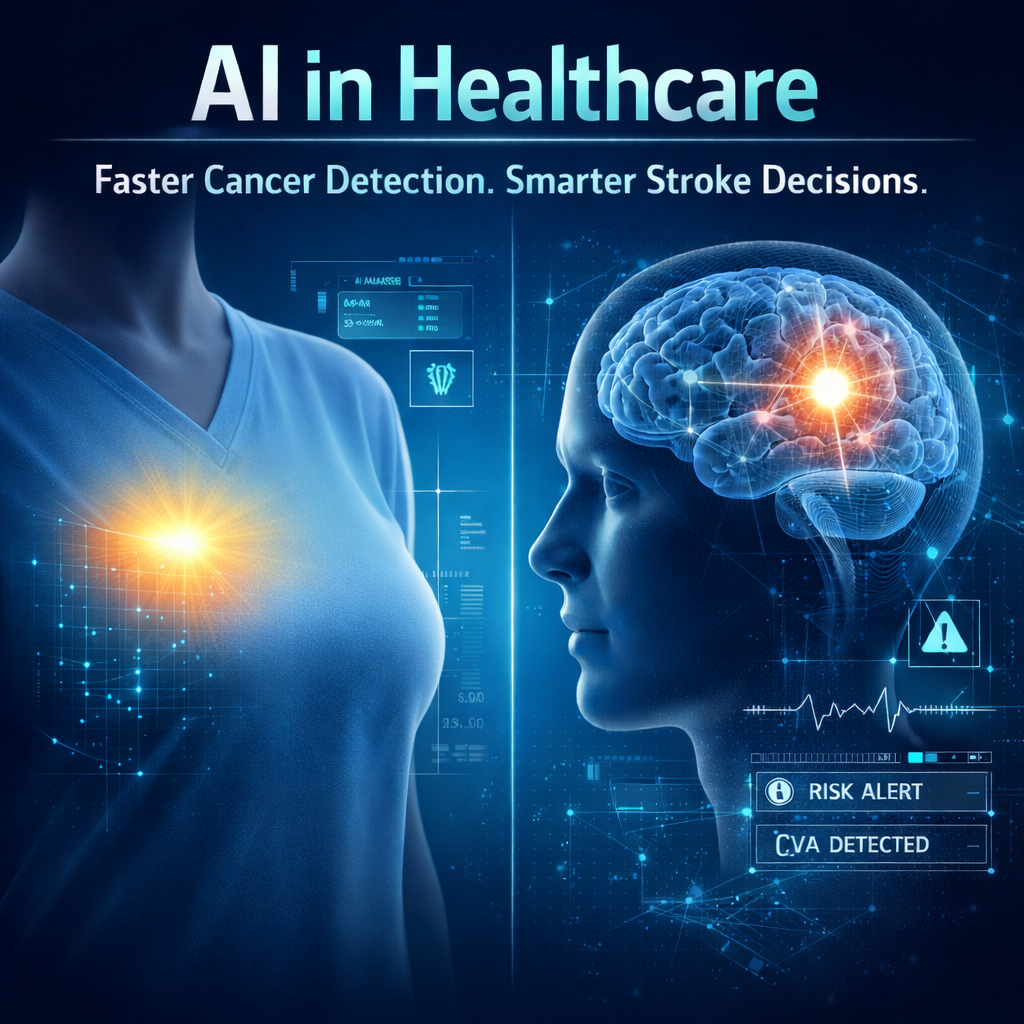
Artificial intelligence (AI) is no longer a concept limited to the tech world. It is rapidly becoming a powerful force in healthcare, helping doctors diagnose diseases earlier, make faster decisions, and improve patient outcomes.
Recent developments show how AI is transforming two critical areas:
Breast cancer screening
Emergency stroke treatment decisions
These breakthroughs signal a shift toward faster, smarter, and more precise medical care.
AI in Breast Cancer Screening: Detecting the Disease Earlier
Breast cancer is one of the most common cancers among women worldwide. One of the biggest challenges has always been early detection, especially when tumors are small or difficult to identify.
How AI Helps
AI systems are now being trained to analyze mammograms (breast X-ray images) with remarkable accuracy. These systems can:
Detect subtle abnormalities that the human eye may miss
Identify early-stage tumors
Reduce false positives and unnecessary biopsies
Assist radiologists in making faster, more confident diagnoses
In several studies, AI has:
matched or exceeded human-level detection accuracy
reduced workload for radiologists
improved screening efficiency
This means more cancers can be detected earlier, when treatment is simpler and survival rates are higher.
AI in Emergency Stroke Care: Faster, Life-Saving Decisions
Stroke treatment is extremely time-sensitive. In many cases, doctors use a drug called thrombolysis to dissolve blood clots. However, this treatment is not safe for every patient.
Giving thrombolysis to the wrong patient can cause severe complications, including brain bleeding.
The New AI Tool
Researchers have developed an AI-based system that can:
Analyze brain scans within seconds
Identify patients who are not suitable for thrombolysis
Support emergency doctors in making faster treatment decisions
Why This Matters
In stroke care:
Every minute of delay leads to brain cell damage
Fast decisions save brain function and lives
AI tools help:
reduce decision time
improve treatment accuracy
prevent harmful interventions
What These Breakthroughs Mean for Patients
AI is not replacing doctors. Instead, it is acting as a decision-support tool that enhances medical care.
For patients, this means:
Earlier Detection
Diseases like cancer can be found sooner
Treatment can begin earlier
Survival chances improve
Faster Emergency Care
Critical decisions made in seconds
Reduced risk of wrong treatments
Better recovery outcomes
More Personalised Treatment
AI systems can analyze large amounts of patient data to:
predict disease risk
guide treatment plans
monitor progress
The Bigger Shift: From Reactive to Predictive Medicine
Traditional healthcare often works like this:
Symptoms appear
Tests are done
Treatment begins
AI is helping shift medicine toward:
Early detection
Risk prediction
Preventive intervention
This approach can:
reduce severe disease cases
lower treatment costs
improve quality of life
Important Reality Check
Despite the excitement, AI in healthcare still has limitations:
It requires high-quality medical data
It must be carefully regulated
Doctors remain essential for final decisions
Technology must be accessible to all patients
AI is a tool, not a replacement for human care.
The Future of AI in Healthcare
In the coming years, AI may help with:
early cancer detection across multiple organs
heart disease risk prediction
chronic pain and nerve disorder management
remote patient monitoring
personalised treatment plans
Healthcare is moving toward a future where technology works alongside doctors to deliver better outcomes.
Final Thought
AI is changing how diseases are detected and treated — not in the distant future, but right now.
From identifying breast cancer earlier to helping doctors make life-saving decisions during strokes, artificial intelligence is becoming a powerful ally in modern medicine.
The goal is not to replace human expertise, but to support it — so patients receive faster, safer, and more effective care.