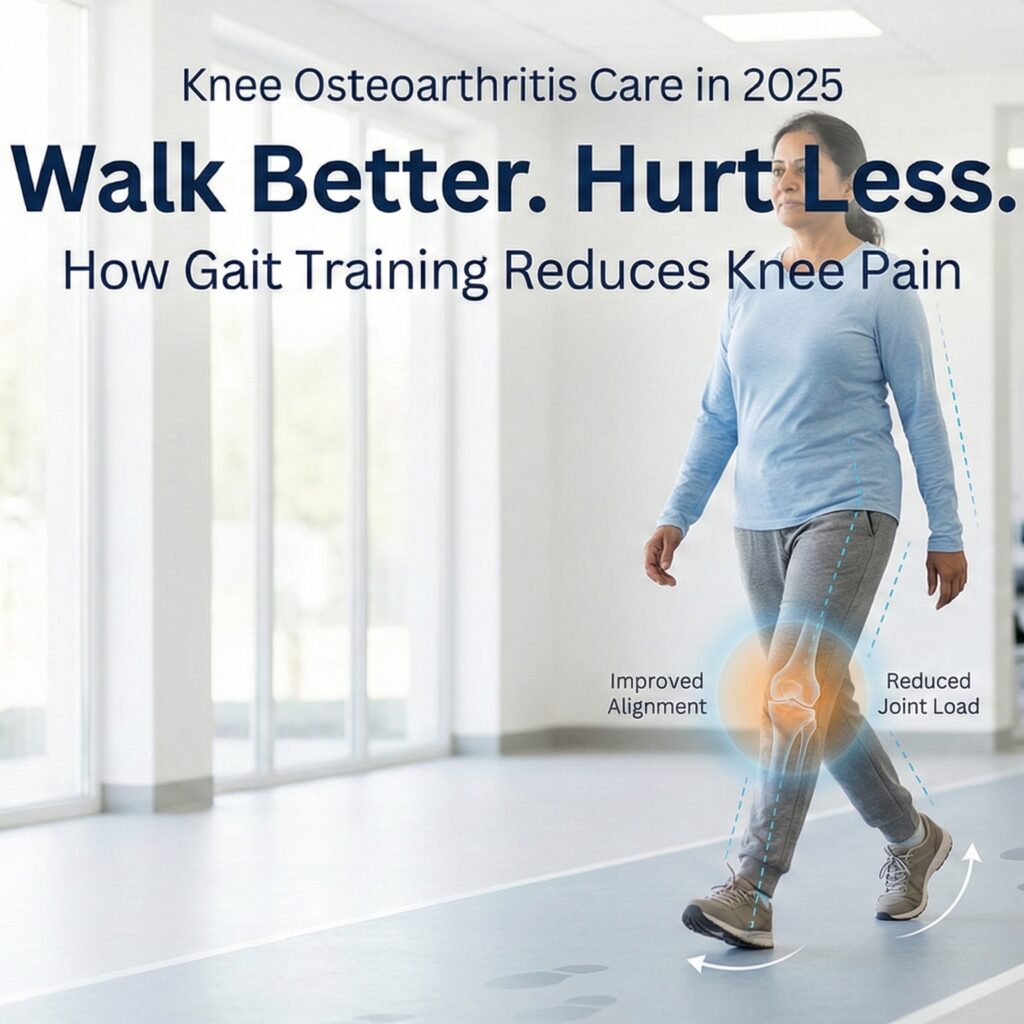
A non-invasive approach gaining attention in 2025
Knee osteoarthritis (OA) is one of the most common joint conditions people face worldwide — and it’s becoming more visible in everyday life. Pain when walking, difficulty climbing stairs, and stiffness after sitting are familiar symptoms for many. Traditionally, treatment has focused on medications, injections, weight management, or surgery. But emerging evidence shows that **something much simpler — the way you walk — can significantly help reduce knee pain and improve joint health.**
This strategy — called gait training or gait retraining — involves making subtle, personalized adjustments to how someone walks, with the goal of reducing stress on the knee joint. It’s a non-invasive, functional, and evidence-based approach that’s gaining attention in clinical practice.
—
🦶 What Is Gait Training?
Gait training is a physical therapy method that focuses on improving the way you walk. Instead of accepting pain as part of osteoarthritis, gait training targets how forces pass through your knees with each step — and teaches you to walk in a way that reduces harmful load on the joint.
Unlike generic walking advice, gait training is personalized — based on an individual’s unique walking pattern. Clinicians assess foot positioning, stride length, balance, weight distribution and then work with the patient to gradually retrain those elements.
—
👣 Why Walking Style Matters for Knee Pain
📌 1. Different Walking Patterns Change Joint Load
Every step you take sends force through your knee joint. Researchers have found that subtle adjustments to walking mechanics — such as changing the angle of your foot placement — can redistribute the pressure within the knee. This can reduce pain and potentially slow structural damage over time.
For example, a randomized controlled trial published in 2025 found that personalized foot angle changes during gait retraining significantly reduced knee pain in people with medial compartment osteoarthritis and may slow cartilage degradation compared to people who did not receive gait adjustments.
📌 2. Better Alignment = Less Stress
Research on gait retraining dates back even further, showing that improving dynamic knee alignment — such as adjusting hip rotation and knee positioning — can decrease harmful knee loading patterns that are common in osteoarthritis.
By refining how the knee moves with each step, gait training helps the joint be more efficient and less overloaded.
—
🧠 What the Latest Research Says
Recent research from institutions like Stanford, the University of Utah and NYU Langone Health supports gait training as a promising method for knee OA management:
Researchers observed that gait retraining produced pain relief similar to that of medication, without pills or surgery.
Some studies also show changes in walking patterns can slow cartilage damage, a key factor in osteoarthritis progression.
Tailored gait modifications have been shown to improve participants’ walking mechanics and reduce joint stress in clinical settings.
Additionally, larger trials continue to investigate gait retraining as a component of knee OA therapy, indicating growing clinical interest and validation.
—
💡 How Gait Training Works in Practice
✔ Personalized Assessment
A therapist evaluates your walking pattern using gait analysis — possibly including video, pressure sensors, or simple clinical observation.
✔ Targeted Adjustments
The therapist may recommend changes such as:
subtle adjustments in foot angle
controlled step length
balanced weight distribution
improved hip/pelvis alignment
✔ Strength and Stability Support
Often, gait training is paired with exercises that improve:
balance
ankle/knee/hip stability
muscle activation patterns
overall walking confidence
✔ Feedback and Practice
Some programs use real-time feedback, even via smartphone sensors or pressure platforms, to help reinforce new gait patterns.
—
🩹 Who Can Benefit Most?
Gait training is especially useful for people with:
mild to moderate knee osteoarthritis
pain with walking that limits activity
early symptoms that interfere with daily function
desire to avoid or delay medication/surgery
It’s important to note that gait changes should be guided by a professional, as incorrect modifications can place stress on other parts of the joint or lower limb.
—
🏃♂️ Walking Isn’t Enough — But It Helps
While simple walking itself has known benefits for knee health and cardiovascular fitness, gait training goes a step further by **optimizing walking mechanics for knee protection.**
For osteoarthritis, walking alone may not change biomechanical loading metrics significantly, but gait training helps target the mechanics behind how that loading occurs — making your walking safer, smarter, and more pain-friendly.
—
🌟 The Big Takeaway
Gait training is not a quick fix — it’s a sustainable, non-invasive, evidence-based approach that helps reduce knee osteoarthritis pain by improving the way you walk.
By redistributing load, improving alignment, and working with your body’s natural movement patterns, gait retraining supports:
✔ reduced pain
✔ improved mobility
✔ less joint stress
✔ better long-term joint health
If you’re living with knee osteoarthritis and struggling with daily activities, gait training might be one of the simplest, most effective tools for ongoing pain relief — without medication or surgery.
—
📞 Need Professional Gait Assessment & Training?
At Dr. Sudhir’s Pain Relief Clinic, we help patients with knee OA through personalized gait analysis and tailored retraining programs that reduce pain and restore mobility.
Call our specialists at +91 91636 95790