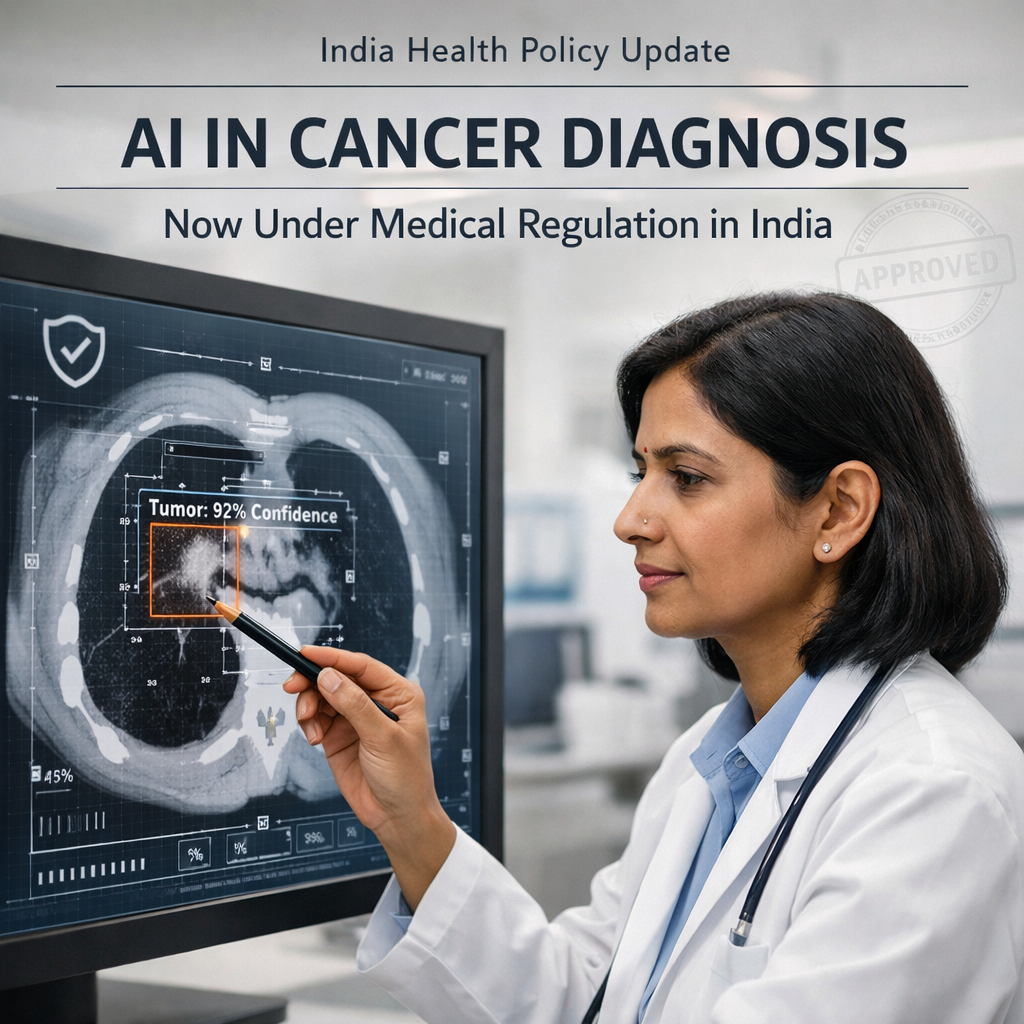
Artificial intelligence (AI) is transforming healthcare around the world — from early detection of disease to faster diagnostic reporting. In India, a major step was taken in early January 2026 when the government introduced new regulatory guidelines for AI-based cancer detection tools, placing them under formal oversight to ensure safety and reliability. �
The Economic Times
This move comes at a time when AI systems are increasingly used in medical imaging and diagnostics, especially for conditions like lung, breast, cervical, and other cancers. But with innovation comes risk — and the government’s latest action aims to strike a balance between technology and patient safety.
🧠 What Exactly Has Changed?
The Central Drugs Standard Control Organisation (CDSCO) — India’s medical device regulator — issued a notification stating that AI-powered software used for cancer detection and diagnosis will now be regulated as Class C medical devices. �
The Economic Times
What that means in practice:
AI tools that analyse medical images such as X-rays, CT scans, MRI, or pathology slides will require:
✔ Official regulatory approval before clinical deployment
✔ Safety validation and performance checks
✔ Continuous monitoring after market launch
✔ Reporting of adverse events or safety issues
These requirements are similar to what traditional medical devices must follow. �
healthbuzz
This classification reflects the fact that AI cancer detection tools are high-risk technologies because diagnostic decisions directly impact patient outcomes.
🩺 Why This Regulation Matters
AI has enormous potential to help detect cancers earlier and more accurately than traditional methods. Some AI systems can rapidly process thousands of images, highlight suspicious areas, and assist doctors — especially in resource-limited settings. �
However, until now, many of these tools were developed and deployed without formal regulatory scrutiny. Without strict oversight:
AI systems might make inaccurate predictions
Biases in training data could lead to uneven performance across populations
Errors or misclassifications could delay treatment or cause unnecessary anxiety
By regulating these tools as medical devices, India aims to ensure that only validated, safe, and effective AI systems are used in hospitals and diagnostic centres. �
healthbuzz
📊 The Safety and Ethics Angle
Healthcare experts have welcomed the move, noting that innovation must be grounded in ethical deployment and patient protection. Such regulations help ensure:
✔ Quality standards are met
✔ Clinical accuracy is verified
✔ Ethical and bias-free application is prioritised
✔ Patients receive reliable diagnostic support
Given that datasets from Indian populations are still evolving, regulation helps ensure AI models are relevant and effective for local patient groups before widespread adoption. �
NDTV Profit
🧬 The Bigger Picture — AI and Cancer Detection
AI technologies rely on machine learning models trained on large datasets of images and clinical data. These algorithms can:
Highlight tumour regions in imaging
Spot patterns that the human eye might miss
Assist radiologists and pathologists with efficiency
Improve early detection rates in screening programmes
But despite exciting advances, regulators and clinicians stress that AI tools should support, not replace, human clinical judgement.
🧑⚕️ What This Means for Patients
For patients, this regulatory update offers several important benefits:
✅ Better Safety Assurance
Only AI tools that pass safety and performance checks will be used — reducing the likelihood of incorrect or misleading results.
✅ Greater Transparency
Manufacturers must demonstrate how their software works and provide evidence of clinical performance.
✅ Ethical Use of AI
Issues like algorithmic bias, privacy, and patient consent become part of the regulatory framework.
✅ More Confidence in Diagnosis
Doctors can use AI outputs with greater trust if the tools have been approved by regulators.
🔍 Challenges Still Ahead
While regulation is a key step, it also highlights some ongoing challenges:
India still needs larger, diverse medical datasets to train robust AI models. �
NDTV Profit
AI tools must be continually reviewed and updated as new data and use cases emerge.
Doctors and radiologists require training to interpret and use AI insights effectively.
🌟 The Future of AI in Indian Healthcare
India’s decision to regulate AI-based cancer detection tools positions the country at the forefront of responsible AI adoption in medicine. It opens the door for:
safer AI diagnostic tools
accelerated digital pathology and imaging innovations
more personalised cancer care pathways
broader acceptance of AI across other disease areas
As AI continues to evolve, regulatory oversight will ensure that technology enhances quality and equity in healthcare, without compromising safety.
📞 Expert Support
If you have questions about cancer screening, early detection, or modern diagnostic tools, talk to our specialists at +91 91636 95790.