For decades, healthcare has followed a familiar pattern:
you feel unwell → you visit a doctor → tests are done → treatment begins.
But by the time symptoms appear, the body has often been struggling silently for months or even years.
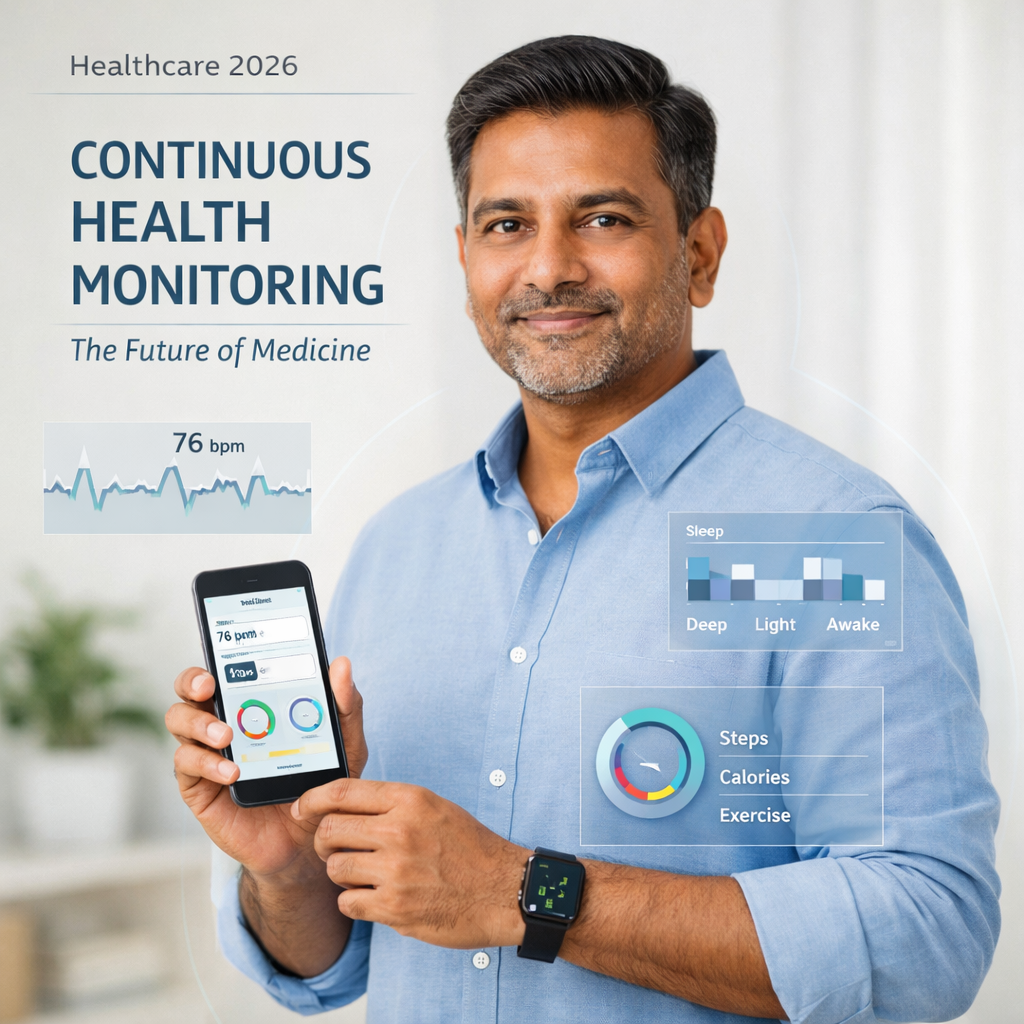
That is why medicine is now moving toward a powerful shift — continuous health monitoring. Instead of checking health only when something goes wrong, modern technology is making it possible to track the body continuously, detect changes early, and intervene before disease takes hold.
This approach is redefining how medicine works — from reactive care to predictive and preventive care.
🧠 What Is Continuous Health Monitoring?
Continuous health monitoring refers to the ongoing collection and analysis of health data over time, rather than relying on occasional tests or clinic visits.
It uses tools such as:
wearables (smartwatches, fitness bands)
smartphone sensors
home health devices
remote monitoring systems
These tools track patterns related to:
heart rate and heart rhythm
sleep quality and recovery
physical activity and movement
stress and nervous system load
oxygen levels and breathing patterns
The key difference is not just data collection, but trend analysis — understanding how your body behaves day after day.
🏥 Why Traditional Healthcare Is No Longer Enough
Traditional healthcare relies heavily on snapshots:
a single blood test
one scan
one clinic visit
While these are important, they miss something critical — context.
The human body does not change suddenly. Most conditions develop gradually:
pain builds slowly
posture deteriorates over time
stress accumulates silently
sleep quality declines progressively
A one-time test may appear normal even while the body is heading toward dysfunction.
Continuous monitoring fills this gap by revealing patterns, deviations, and early warning signs that single tests cannot catch.
🔍 What Continuous Monitoring Can Detect Early
Continuous health data can reveal subtle but meaningful changes, such as:
rising resting heart rate (stress, fatigue, illness)
declining sleep quality (nervous system overload)
reduced movement efficiency (early joint or spine issues)
increased recovery time after activity
irregular heart rhythm patterns
These changes often appear long before pain, fatigue, or disease becomes obvious.
🧠 The Shift From Treating Disease to Preventing It
This is the most important transformation in modern medicine.
Old model:
Wait for symptoms
Diagnose disease
Treat damage
New model:
Observe trends
Identify risk early
Prevent progression
Continuous monitoring allows doctors to:
guide lifestyle changes early
adjust activity and recovery
reduce long-term complications
personalize care instead of using generic advice
This approach is especially powerful for chronic conditions, pain disorders, and lifestyle-related health issues.
📱 Why Wearables and Smart Devices Matter
Modern wearables are no longer simple step counters.
They can now track:
heart rate variability (stress and recovery)
sleep stages
oxygen saturation
activity balance
posture and movement patterns
When combined with AI and data analytics, these devices help identify when the body is under strain — even if you feel “fine.”
This is particularly useful for:
working professionals
people with recurring pain
individuals under chronic stress
those managing long-term conditions
🧬 Continuous Monitoring and Pain Prevention
Pain is rarely sudden. It is often the result of:
repeated overload
poor recovery
prolonged stress
faulty movement patterns
Continuous monitoring helps identify:
insufficient recovery
excessive sedentary time
stress-related physiological changes
declining movement quality
By addressing these factors early, long-term pain can often be prevented rather than treated later.
⚠️ What Continuous Monitoring Is NOT
It is important to clarify:
It does not replace doctors
It does not diagnose disease on its own
It should not cause anxiety or over-monitoring
Instead, it acts as:
an early warning system that supports better medical decisions.
Human clinical evaluation remains essential. Technology provides awareness — doctors provide interpretation and care.
🧠 Privacy, Accuracy, and Responsible Use
As continuous monitoring grows, so do concerns about:
data privacy
accuracy of devices
misuse of health data
This is why medical-grade validation, ethical standards, and regulation are becoming increasingly important.
Patients should:
use trusted devices
avoid self-diagnosing
consult professionals when data shows concerning trends
🌍 The Future of Medicine Is Already Here
Healthcare is moving toward:
personalized health baselines
long-term trend tracking
early intervention
fewer emergency treatments
better quality of life
Continuous health monitoring is not about living under surveillance — it’s about understanding your body before it starts failing.
🏥 How This Fits Into Preventive Care
At modern clinics like Dr. Sudhir’s Pain Relief Clinic, the focus is shifting toward:
early detection
posture and movement analysis
nervous system balance
lifestyle-aware care
Continuous monitoring aligns perfectly with this philosophy — helping patients stay ahead of problems instead of reacting to them.
🌟 Final Thought
The future of medicine is not about more tests — it’s about better timing.
When health is monitored continuously, small problems don’t become big ones.
Pain doesn’t become chronic.
Stress doesn’t silently damage the body.
Continuous health monitoring empowers both patients and doctors to act before damage is done.
That is why it represents the future of medicine.