
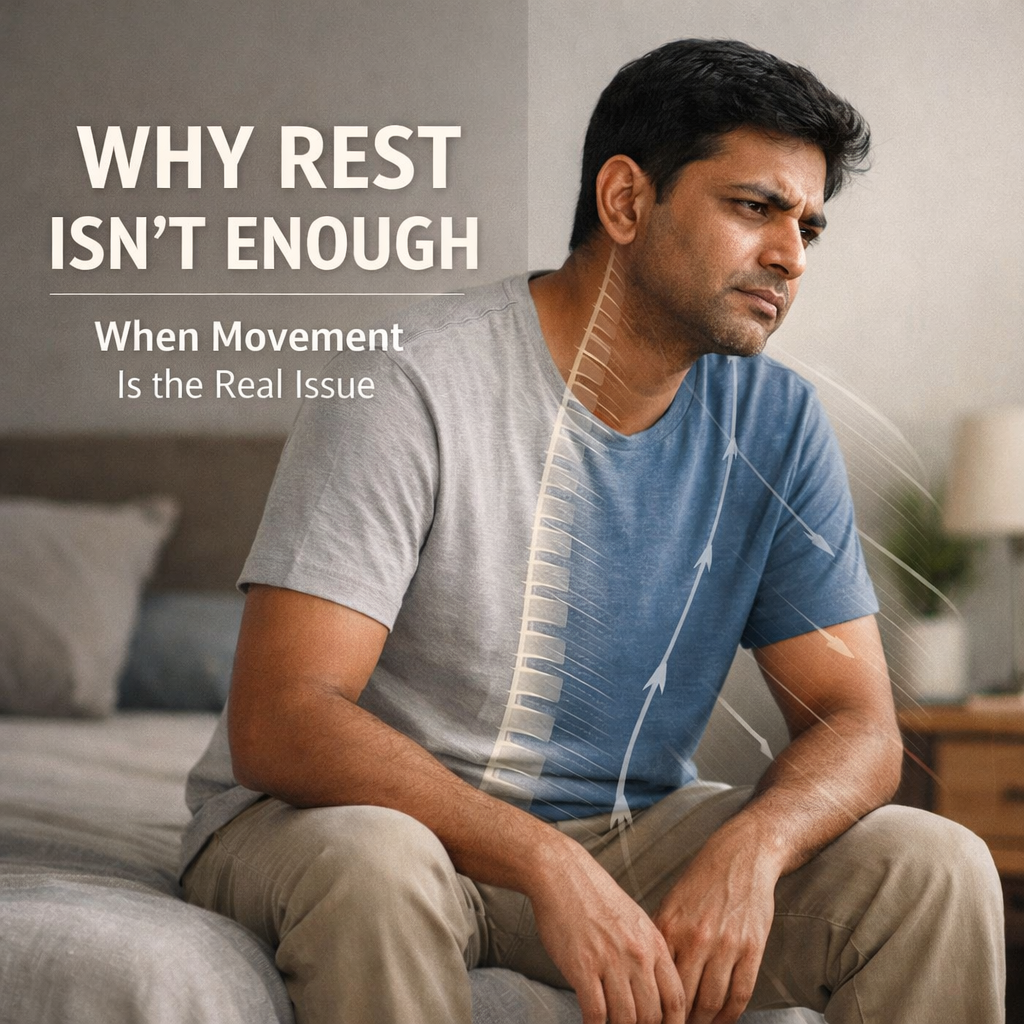
We’ve all been taught the same rule since childhood:
If something hurts, rest it.
And sometimes, that works.
But many people experience something confusing — even frustrating:
They rest for days, sometimes weeks…
Yet the pain returns the moment they move again.
So what’s really happening?
The truth is uncomfortable but important to understand:
Not all pain is caused by damage — and not all pain can be fixed by rest.
The Old Assumption: Pain Equals Injury
Traditional thinking assumes:
pain = tissue damage
rest = healing
This works well for acute injuries:
fractures
muscle tears
severe sprains
But modern pain is often not acute.
It’s repetitive, adaptive, and lifestyle-driven.
And that changes everything.
When Movement Is the Trigger — Not the Cause
Many pain problems don’t start with one wrong move.
They build quietly through:
repeated postures
poor load distribution
lack of movement variety
prolonged sitting or standing
constant screen use
Movement doesn’t create the problem —
it reveals it.
Rest may calm symptoms temporarily, but it doesn’t correct the underlying pattern.
Why Rest Can Sometimes Make Things Worse
This is the part people rarely talk about.
1. Rest Removes Symptoms, Not Causes
When you rest:
inflammation reduces
muscles relax
pain signals quiet down
But the body remembers the faulty pattern.
The moment you return to normal life, the same load goes back to the same stressed structures.
2. The Body Adapts to Stillness
Extended rest leads to:
muscle deconditioning
reduced joint tolerance
lowered movement confidence
Now, when movement resumes, the body feels less prepared, not more healed.
3. The Nervous System Learns Pain
Pain is not only mechanical — it’s neurological.
If pain keeps returning:
the nervous system becomes protective
muscles tighten earlier
movement becomes guarded
This creates pain without new injury.
Pain as a Compensation Problem
Many chronic pain cases are not failures of healing —
they are failures of load management.
The body compensates when:
one area is weak
another is stiff
posture distributes weight poorly
These compensations work… until they don’t.
Pain appears after the system runs out of options.
Why “Feeling Fine at Rest” Can Be Misleading
A dangerous pattern many people fall into:
Pain disappears during rest
Pain returns during activity
Rest is repeated
Confidence in movement drops
This leads to:
fear of movement
over-resting
worsening tolerance
Pain becomes a movement problem, not a rest problem.
What Actually Fixes Movement-Related Pain
The solution isn’t forcing movement —
and it’s not endless rest either.
It’s correct movement with awareness.
✔ Rest + Re-education
Rest calms symptoms.
Re-education prevents recurrence.
✔ Load Redistribution
Instead of asking “Why does it hurt?”
The better question is:
“Where is the load going — and why?”
✔ Nervous System Reset
Pain persists when the body feels unsafe.
Calm, graded movement teaches the nervous system that motion is not a threat.
✔ Individual Assessment (Not Generic Advice)
Two people with the same pain may have completely different causes.
This is why personalised evaluation matters.
At the best pain clinic in Kolkata, pain is approached as a system issue, not just a sore spot.
When You Should Seek Professional Help
You should not rely on rest alone if:
pain keeps returning after rest
pain shifts locations
stiffness lasts all day
movement feels “wrong” rather than painful
scans look normal but pain persists
These are signs of functional pain, not injury.
Why Modern Clinics Look Beyond Rest
At advanced pain centres, including the best pain clinic in Kolkata, treatment focuses on:
movement patterns
posture mechanics
nervous system sensitivity
lifestyle load
Because the goal is not short-term relief —
it’s long-term resilience.
Final Thought
Rest is not wrong.
But rest is incomplete.
Pain caused by movement often needs movement to be fixed — just the right kind, at the right time, in the right way.
When pain keeps returning, it’s not because your body is weak.
It’s because it’s been compensating quietly for too long.
Understanding that changes everything.