You don’t feel it.
You don’t think about it.
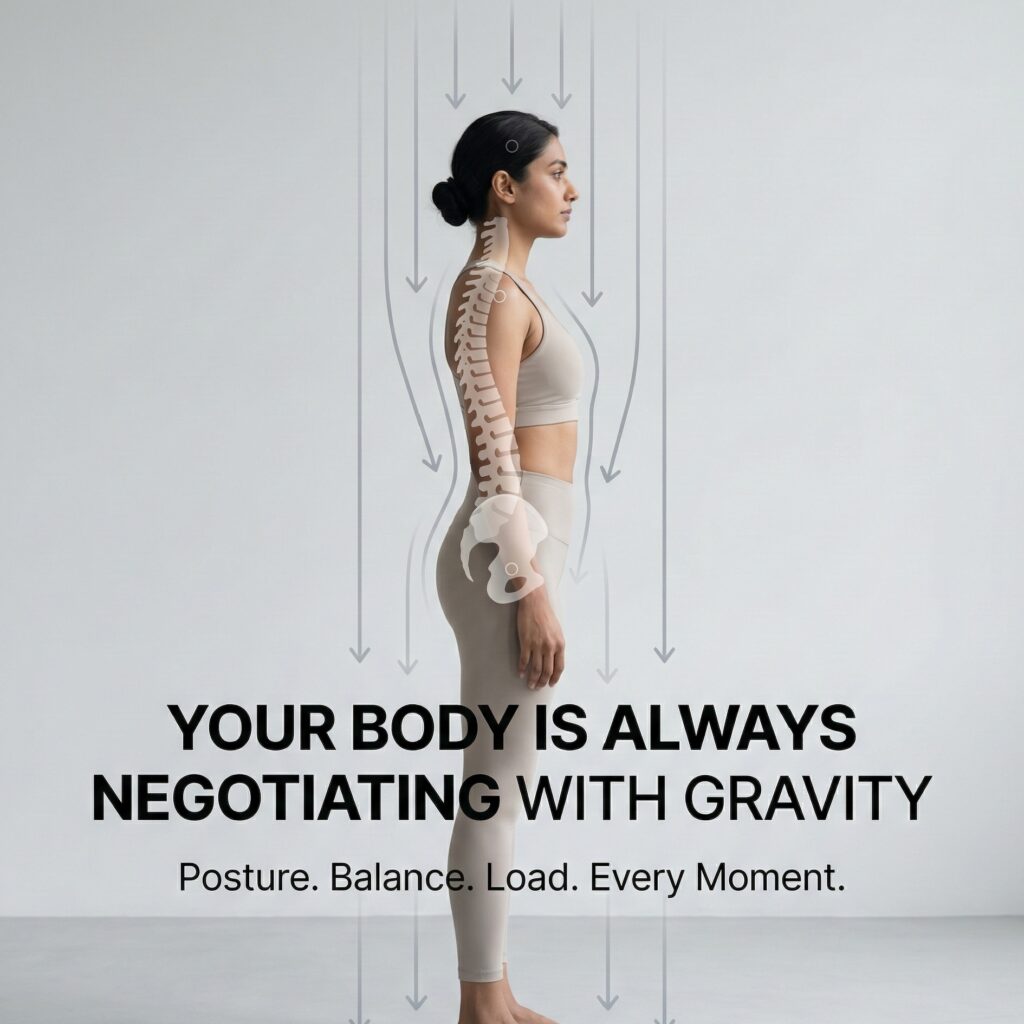
But from the moment you wake up until you lie down at night, your body is in a constant negotiation with gravity.
Not a fight.
Not a collapse.
A negotiation.
Every step you take, every hour you sit, every time you bend, scroll, stand, or slouch — your body is quietly deciding how to resist gravity without wasting too much energy.
And that decision shapes your posture, your movement, your fatigue, and eventually… your pain.
Gravity Is Not the Enemy — But It Is Relentless
Gravity isn’t harmful.
It’s constant.
Your body evolved to live with it through:
a curved spine
layered muscle support
flexible joints
dynamic balance
When everything works well, gravity feels invisible.
But modern life has changed how often and how well this negotiation happens.
The Hidden Cost of Staying Upright
Standing upright is not passive.
To stay vertical, your body must:
keep the head balanced over the spine
distribute weight evenly through joints
adjust muscles constantly to prevent collapse
This is why:
standing still feels tiring after a while
sitting “comfortably” can still cause strain
poor posture feels normal until it doesn’t
Your body is always asking:
“What’s the least effort I can use right now?”
Over time, that question changes your mechanics.
How Modern Habits Change the Negotiation
1. Sitting for Long Hours
When you sit for too long:
gravity shifts load to the lower spine
muscles switch off
joints take more pressure
The body adapts by stiffening.
Stiffness is not damage — it’s a protective strategy.
2. Forward Head & Screen Use
Your head weighs about 4–5 kg.
As it moves forward:
gravity multiplies its load
the neck works harder
shoulders round
upper back tightens
The body accepts this position because it feels stable — not because it’s healthy.
3. Reduced Movement Variety
Your body negotiates best when movement changes.
But repetitive days create repetitive loads:
same chair
same posture
same angles
The body adapts to predictability by overusing the same structures.
That’s when pain appears.
Pain Is Often a Failed Negotiation
Pain usually doesn’t mean:
“Something suddenly broke.”
More often it means:
“The body has been compensating for too long.”
Before pain, there is:
tightness
heaviness
reduced flexibility
fatigue without effort
Pain is what happens when the body can no longer negotiate quietly.
Why Gravity Affects Everyone Differently
Two people can live the same lifestyle and feel different outcomes because:
body structure varies
muscle balance differs
recovery capacity is unique
stress and sleep affect resilience
Your body’s negotiation with gravity is personal.
That’s why generic advice often fails.
The Nervous System Is Part of the Deal
This negotiation isn’t just mechanical — it’s neurological.
Your nervous system decides:
which muscles stay active
which relax
when stiffness is “necessary”
Under stress or fatigue, the nervous system chooses stability over flexibility.
That’s why:
stress makes the body feel heavier
anxiety tightens the neck and back
winter increases stiffness
It’s not weakness.
It’s protection.
What Helps the Body Negotiate Better
The solution isn’t fighting gravity harder.
It’s helping the body distribute the load more intelligently.
✔ Movement Variation
Frequent changes reduce repetitive stress.
✔ Postural Awareness (Not Perfection)
The goal isn’t straight posture — it’s not staying collapsed too long.
✔ Strength Where Support Is Needed
Core, hips, and upper back help share gravitational load.
✔ Recovery and Circulation
Sleep, warmth, and movement restore tissue resilience.
Why Ignoring This Leads to Chronic Issues
When the body negotiates poorly for too long:
joints take excess pressure
muscles stay overactive
nerves become sensitive
That’s how:
back pain becomes chronic
neck stiffness becomes “normal”
fatigue becomes constant
None of this happens overnight.
Final Thought
Your body isn’t lazy.
It isn’t fragile.
It’s intelligent — constantly adapting to gravity with the least effort possible.
But adaptation without balance has consequences.
When you understand that your body is always negotiating with gravity, pain stops feeling random — and starts making sense.
Awareness is the first step toward changing the negotiation.